


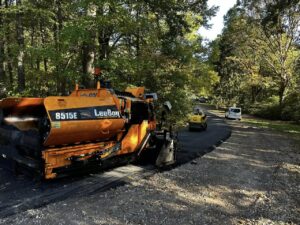
 When a homeowner in a forested corner of Charlotte, NC called us, they had a clear vision: a clean, durable asphalt roadway winding through heavy tree cover, blending with nature while performing flawlessly for years.
That kind of balance is exactly what motivates us at Regional Asphalt Services, Inc. Every driveway we pave is more than blacktop — it’s a lasting welcome to the home.
From Trees to Tarmac: A Road with Constraints
This private road would pass through dense woods. The area posed two big challenges:
- Limited access for machinery. Narrow clearances made it tricky for a paver, roller, and support trucks to maneuver.
- Uneven and subpar gravel base. Without a strong, stable foundation, even the best asphalt overlay can fail prematurely.
Throw in the fact that heavy shading from overhanging canopies affects how water drains and asphalt cures, and you have a job that demands both finesse and muscle.
How We Solved It — Step by Step
1. Careful Planning Around the Trees
We began by walking the entire road alignment with the homeowner, marking precise turns, width constraints, and critical sections where tree limbs would need trimming (or protection). Our priority: minimal disturbance to the environment.
We decided in advance where our pull-offs and staging areas would go, staying clear of native roots and sensitive zones.
2. Subgrade and Gravel Correction
Under the original loose and irregular gravel, there were dips, washouts, and soft spots. We graded the surface, added necessary fill material, and compacted it carefully to achieve uniform slope and drainage.
In places where root action or shade had held moisture, we introduced better drainage lines so water wouldn’t stagnate under the pavement.
3. Setting up for the Asphalt
Space being tight, we brought in a LeeBoy 8515E asphalt paver — compact but powerful. We also used a Wacker Neuson roller for tight, yet efficient compaction. These machines offered surprising maneuverability without sacrificing performance.
4. Paving With Precision
With the base ready, we laid fresh asphalt in one continuous pass where possible, adjusting our speed to maintain temperature and smoothness under heavy tree shadows.
Our crew monitored edge control constantly to avoid overrun (which is especially visible when surrounded by foliage). We achieved clean, well-defined edges that matched the homeowners’ expectations for a neat finish.
5. Final Rolling and Inspection
Once laid, the asphalt underwent multiple compaction passes, ensuring full density and bonding to the gravel beneath. Our crew then walked every joint, ramp, and transition, ensuring no loose stones, no burrs, and no drainage issues.
Seamless Asphalt Meets Your Gates
- The homeowner now drives over a smooth, durable surface that flows through the trees without feeling intrusive
- Transitions from gravel to asphalt are nearly invisible — no sudden “jumps” or edges
- Edges are crisp and clean, with no overrun spilling into the woodland
- With the correct base prep and drainage work, the road is protected against long-term moisture, root pressure, and shaded decay
“Once the sun hits it in the morning, you’d never guess it winds through a dense forest,” the homeowner told us after the first rain settled.
Let’s Pave the Way Through Your Property—Smoothly and Sustainably
Ready to transform your private road — even through tricky terrain or tree cover?
Contact us today for a site evaluation. We’ll walk with you down the proposed alignment, assess your base conditions, and deliver a plan that respects your land and your investment.


