


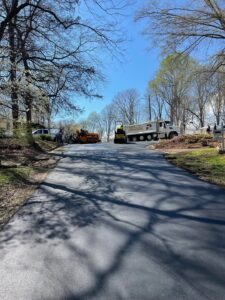
 There are few things more frustrating for homeowners than navigating a rough, worn road just to get to their own driveway. When the community association of a well-established subdivision in Charlotte, NC approached us, Regional Asphalt Services, Inc., they asked for two things: safer, smoother travel for residents, and a fresh, clean look that would last through seasons.
This was more than a “resurface and go” job.
The existing pavement had seen decades of wear, and the road sat on a steep incline with strict landscaping on both sides. What you see now is not just blacktop. You’re witnessing a careful dance of grading, paving, and coordination in a mature neighborhood.
From Worn to Wow: Where We Started
When we first walked the site in early spring, several issues became clear:
- The surface was uneven, full of ruts and wear lines from past patching.
- The grade of the roadway was critical: water had to shed efficiently toward drainage areas.
- The road corridor was narrow, flanked by mature trees and landscaping. Any mistake with heavy machinery or paving trucks could damage root systems, curbs, and gardens.
- Given the timing (early in the paving season), ambient and surface temperature swings threatened proper asphalt curing.
Our client’s goals were straightforward, but the path to them required precision.
Planning for Precision on a Steep Grade
1. Laser-Guided Grading
Because of the steep slope, achieving consistent asphalt thickness and uniform slope was nonnegotiable. We used laser-grade controls on our milling and grading machines to maintain the correct crown and fall for water runoff. This allowed us to avoid “pooling” at low spots, which often become deterioration zones over time.
2. Tight Staging and Crew Coordination
Working in a live residential neighborhood meant that traffic control and scheduling were critical.
We broke the project into segments so that only one stretch was active at a time.
Our asphalt paving, rolling, and cleanup crews operated in tight sequence so that disruption to residents was minimal—even though we were running heavy equipment.
3. Edge-Sensitive Handling
Because the road was lined with established trees and plantings, we deployed small wheeled pavers and milling machines near the edges, and soft-mat tracks where needed.
Every grade and compaction pass kept within strict tolerances, avoiding encroachment into tree root zones or gardens.
4. Temperature Management
We scheduled paving runs carefully, starting as early as the asphalt plant could load in the morning and seeking to finish before late afternoon cooling set in. We monitored mix temperature, base temperature, and ambient readings to maintain compaction windows.
Our crews adapted rolling patterns as surface temperatures dropped.
The Transformation: What Homeowners Experience Now
By midday on the closing week, we achieved:
- A smooth, uniformly compacted blacktop surface that immediately improved vehicle handling.
- Precisely maintained road slope, ensuring effective drainage and reducing long-term wear.
- No visible damage to adjacent landscaping, curbs, or tree roots—neighbors told us they could barely tell crews had been present beyond the fresh asphalt.
- A strong visual upgrade from faded, rutty pavement to bold, clean streets—a curb appeal boost for the entire subdivision.
We completed the full stretch without major traffic lockouts or complaints. The community association was thrilled with the outcome.
What Made This Project Work — and Why It Matters for Your Subdivision
This project shows how much more goes into paving than just laying asphalt. For subdivisions in Charlotte or anywhere with steep terrain and mature landscaping, success depends on:
- Laser-controlled grading for consistent slope
- Tight coordination across equipment, traffic control, and crews
- Sensitive edge handling near landscaping
- Timing the work to avoid thermal constraints
If your streets are showing age, or your next paving project has challenging terrain, we’d love to show you what we’ve done in similar settings. Contact us, and let us walk your site in Charlotte (or nearby).


